Njangi Credit Score · NCS

The first behavioural credential
built for African finance.

A credit score that does not depend on your bank account, your salary slip, or whether your country has a credit bureau. The Njangi Credit Score reads what informal African finance has always known how to read — whether you keep your word in a community of trust.

Today, your score moves with every contribution you make to a circle, every cycle you complete, every endorsement you earn from peers. Tomorrow, it becomes the credential the rest of the financial world finally accepts.

01 · The mission

By 2050: Africa's first unanimously accepted credit system.

The credit score that exists in most parts of the world does not exist in most parts of Africa. Where it does exist — in three or four markets — it covers a fraction of the adult population, requires a formal-sector job to enter, and quietly excludes the majority of working people who manage their finances in the informal economy. The result is a continent of borrowers who have spent decades demonstrating reliability without accumulating any record of it.

The Njangi Credit Score is built to fix that. Not as a copy of FICO or Equifax adapted for Africa, but as a fundamentally different kind of credential — one that scores the financial behaviour African communities have always practised at scale: contributing to a circle on time, completing a cycle without defaulting, settling disputes fairly, vouching for trusted peers, building a wallet over years rather than months.

This is a multigenerational project. The score you build today is the credential your children inherit the foundations of tomorrow. By 2050, our ambition is for the NCS to be the credit signal a Cameroonian student carries into a Lagos apartment lease, that a Ghanaian entrepreneur presents to a Kenyan bank, that a Senegalese parent uses to underwrite their child's first car loan in Dakar. One credential. One continent. Recognised everywhere it matters.

02 · What the NCS measures

Not your salary. Not your assets. Your word, kept.

A traditional credit score is built primarily from formal-sector signals: how much credit you have available, how much you have used, whether you have repaid loans on time, how long your credit history is, what mix of credit products you hold. Across most of Africa, the majority of adults have never been issued any of these instruments — through no fault of their own. They are, statistically, "credit invisible."

The NCS reads a different signal. It reads contribution behaviour inside trusted communities. When you join a Njangi circle and your turn to contribute comes around, do you contribute on time? When the cycle reaches its natural end, do you complete it? When a dispute arises, do you participate in good faith? When peers know you well enough to endorse you, do they? When you keep funds in your wallet, do you build a relationship with the platform over time?

Each of these is a behavioural data point that African finance has always recognised — but that has never been captured at scale, anchored to identity, or made portable across institutions. The NCS captures all of it, scores it according to a transparent formula, and presents it as a credential that becomes more valuable the longer you use it. It is not a copy of Western credit. It is a credit system rooted in how trust actually works on this continent.

03 · The five components

Five inputs. Weighted and explained.

Your NCS score is calculated from five behavioural signals, each carrying a different weight. The weights reflect what genuinely predicts trustworthiness in a community-finance context — not what looks good in a marketing slide. Reliability is the largest contributor at 35% because in informal finance, a person who pays on time is by far the most predictable indicator of a person who will keep paying on time. The full breakdown is below, and the formula is shown in the fine print at the foot of this section.

Reliability
35%

The percentage of your contribution obligations met on or before the due date, across every Njangi and Pool you belong to. This is the heaviest weight because in community finance, reliability is the single strongest predictor of future reliability. A person who contributes on time twenty cycles in a row is exactly the kind of person communities are right to trust — and lenders, eventually, should be too.

Completion
25%

Of every cycle you have started in a Njangi, what proportion did you finish? Joining a circle and contributing for two months before disappearing is a different signal from joining and completing the full ten-month cycle. The completion ratio is what distinguishes a temporary participant from a long-term member.

Default recovery
20%

Everyone misses occasionally. What matters is what happens next. Missed contributions that are recovered through good-faith catch-up — within an agreed window — are scored very differently from missed contributions that escalate into defaults. Default recovery rewards the resilience of someone who falls and gets back up over the smoothness of someone who never had to.

Social trust
10%

Endorsements from peers you have actually completed circles with. Not abstract reviews from strangers — explicit vouches from people who have already trusted you with their money. Social trust is capped at 10% to prevent gaming, and it can be lost as easily as it is gained: a withdrawn endorsement carries weight too.

Wallet history
10%

The depth and consistency of your relationship with the platform itself. Time since signup, average wallet balance held, frequency of activity, KYC level completed. This is the slowest-moving component — measured in months and years rather than days — which makes it the most resistant to manipulation. Long-term users earn a structural edge that no short-term trick can replicate.

Fine print · how the score is calculated

The Njangi Credit Score is a weighted composite scored on a 300–850 scale, modelled on conventional credit-bureau ranges to make the output legible to people already familiar with FICO. Every Sohana account starts at 300 with the platform's lowest tier of trust granted; the score then moves with each behavioural event recorded against the account.

NCS = 300 + 550 × ( 0.35·R + 0.25·C + 0.20·D + 0.10·S + 0.10·W )

Where R is reliability (proportion of on-time contributions, normalised), C is completion (proportion of started cycles finished), D is default recovery (a smoothed function of missed-then-recovered events), S is social trust (endorsement net score, capped), and W is wallet history (a logarithmic function of account age and activity). Each component is normalised to the 0–1 range before being weighted.

Scores are recomputed in real time on every qualifying event. The most influential event is a completed cycle (+12 points before normalisation), followed by an on-time contribution (+8), a recovered late contribution (+5), and a peer endorsement (+3). The most damaging events are a defaulted cycle (−30), a missed contribution (−18), and a withdrawn endorsement (−2). The full event-delta table appears in the section below. The formula and weights will not change without published notice and a transition window for users; this is a multigenerational tool and stability matters more than tuning.

04 · Four tiers

Each tier unlocks something.

As your score climbs, your standing on the platform improves. Higher tiers unlock larger circle sizes, lower fees, and access to liquidity products. Tiers are not just a label — they are the mechanism by which Sohana rewards consistent behaviour with material upside, and by which partner institutions outside Sohana will, over time, recognise NCS as a credible signal.

Probation 300–549

The starting line

Every new account begins here. Probation is not a punishment — it is the platform's responsible default for users who have not yet demonstrated their pattern. The goal is to graduate, and most active users do so within their first or second completed cycle.

  • Join small Njangis (up to 5 members)
  • Basic wallet operations enabled
  • Full access to score history & coaching
Developing 550–649

Building the pattern

You have demonstrated initial reliability — usually a few on-time contributions and a completed cycle or two. You can now join most Njangis on the platform, including those with stricter member criteria, and unlock the first tier of liquidity support.

  • Join most Njangis on the platform
  • Access to emergency liquidity loans
  • Personalised NCS coaching tips
Reliable 650–749

The trusted core

You are a user the platform — and your peers — can rely on. You have likely completed multiple cycles, kept disputes minimal, and built a wallet history that demonstrates ongoing engagement. Reliable-tier benefits make every other product on Sohana cheaper and more powerful.

  • All Njangis available — no size limit
  • Early-payout liquidity loans
  • 0.5% fee discount on operations
  • Priority support & free Njangi creation
Exemplary 750–850

The standard-bearers

The top tier. Reaching exemplary takes time — usually multiple years of sustained behaviour across many circles. Exemplary users are the credibility infrastructure of the entire platform. They get the full benefit suite, partner perks, and — once we begin formal credit-bureau reporting — the strongest external signal of all.

  • Maximum loan amounts available
  • Reported to credit bureaus (where supported)
  • Operator privileges & beta access
  • Free Njangi & Pool creation · all partner perks unlocked
05 · What moves the score

Every action on the books.

The full table of events that affect your NCS, with the exact point delta applied to each. There are no hidden multipliers, no "judgement adjustments" by an unknown algorithm, and no events that are weighted differently for different users. Every NCS holder on the platform sees the same numbers below.

Event What it means Points
Cycle completed You finished a full Njangi cycle without default. The strongest positive signal. +12
Contribution on time You met a contribution obligation on or before its due date. +8
Contribution recovered You missed a contribution but caught up within the agreed grace window. +5
Dispute resolved A formal dispute involving you was closed with a resolution favourable to your conduct. +4
Peer endorsement Another verified user vouched for your reliability after a completed circle. +3
Wallet deposit You added funds to your Sohana wallet. Small, slow signal of active engagement. +1
Endorsement removed A peer who previously endorsed you withdrew their endorsement. −2
Contribution late You missed a contribution due date — but the grace window has not yet closed. −5
Dispute raised against you A formal dispute was opened against your conduct in a Njangi or Pool. −8
Contribution missed You failed to make a contribution and the grace window expired without recovery. −18
Cycle defaulted You exited a Njangi without completing your obligations. The largest negative signal. −30

Point deltas are pre-normalisation values. After each event, all components are re-normalised and the score is recomputed via the formula above, so the actual change observed in your displayed score may differ from the delta — and will scale with how much history you already have. New users see larger swings; long-tenured users see smaller, more stable movements.

06 · The Circle Passport

A digital résumé that travels with you.

The Circle Passport is your portable NCS credential — a compact, beautifully designed digital document that summarises your entire Sohana history at a glance. Score. Tier. Years on the platform. Cycles completed. Reliability percentage. Endorsements earned. Badges. Every figure that matters, in one place. Designed to be presented to a landlord, a lender, a partner business, or simply to look at when you want to feel proud of what you have built.

Today the passport lives inside Sohana. As we secure partnerships across the continent, the same passport becomes a credential you can present off-platform — verified cryptographically, owned by you, never sold to anyone. It is the visible artefact of years of trustworthy behaviour.
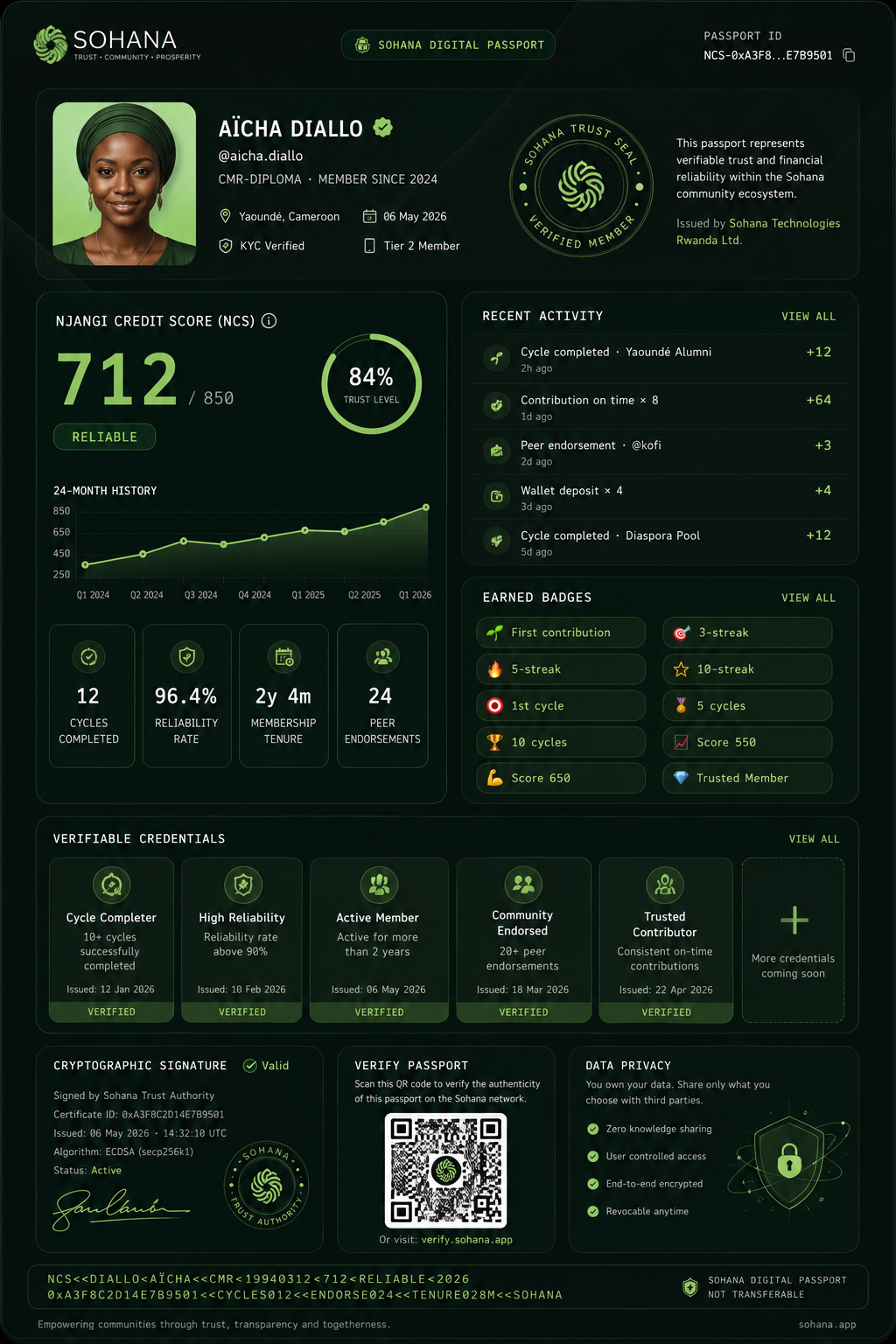
AD
@aïcha.diallo
Aïcha Diallo
CMR-DIPLOMA · MEMBER SINCE 2024
NCS
VERIFIED
2026
Current Score
712 / 850 Reliable
24-month history
Q1 2024 · 480 Q1 2026 · 712
12
Cycles completed
96.4%
Reliability
2y 4m
Tenure
24
Endorsements
Recent activity
Cycle completed · Yaoundé Alumni+12
Contribution on time × 8+64
Peer endorsement · @kofi+3
Wallet deposit × 4+4
Cycle completed · Diaspora Pool+12
Earned badges
🌱First contribution 🎯3-streak 🔥5-streak 10-streak 1st cycle 🏅5 cycles 🏆10 cycles 📈Score 550 💪Score 650
NCS<<DIALLO<AICHA<<CMR<19940312<712<RELIABLE<2026
<<<<0xA3F8C2D14E7B9501<<CYCLES012<ENDORSE024<TENURE028M

Above is a representative example of a Circle Passport. Real passports are generated for every Sohana account from their actual on-platform history. The passport is yours, owned by you, and never displayed without your active permission. Cryptographic signing and external verification are scheduled for the 2027 platform release.

07 · Try the simulator

Pick events. Watch the score move.

Below is a working simulator that uses the same point deltas as the real NCS engine. Start with a fresh account at 300, then click any event to see how the score moves and which tier it lands in. The platform behaves identically, in real time, against your actual account history.

Click any event to apply it

Your simulated NCS
300
Probation
Click any event on the left to apply it.
08 · The partnership economy

Real perks for real reliability — across the continent.

A credit score is only valuable if it unlocks something. As the NCS scales, we are partnering with hotels, banks, telecommunications operators, insurance providers, education institutions, and mobility services across Africa — each bringing a real benefit that good NCS holders can claim. The categories below sketch the partnership landscape we are building. Specific partner brands will be announced as agreements are signed and cleared for launch.

Every perk follows the same logic: trustworthy users cost partners less to serve, and that cost saving gets shared back with the user as a real benefit. A reliable hotel guest is worth more to a hotel than a stranger. A well-scored borrower is worth more to a bank. A safe driver is worth more to an insurer. The NCS is the credible signal that quantifies that worth — and the partnership economy is how the value flows back.

Hotels & hospitality

Skip the deposit. Get the upgrade.

Hotels lose money on damage deposits, no-shows, and uncertainty about new guests. NCS-verified guests reduce that risk dramatically — and the hotel can pass the savings back as preferential treatment.

Reliable+ Waived security deposits, room upgrades on availability, late checkout, partner loyalty pre-credit.
Banks & lenders

Lower rates. Higher limits. Faster decisions.

Banks across the continent struggle to underwrite informal-sector applicants. The NCS gives them a defensible signal of repayment behaviour — letting them serve more people with confidence and price risk fairly.

Reliable+ Reduced interest rates, higher pre-approved credit limits, accelerated personal-loan decisions, fee waivers on first products.
Telecoms & mobile

Devices on terms. Plans without prepay.

Mobile-network operators issue handsets, data plans, and post-paid packages — all of which carry repayment risk. NCS-verified subscribers can be offered post-paid plans and device financing without the punitive prepayment screening.

Developing+ Post-paid eligibility without prepayment, device-financing instalments, premium-tier service on day one.
Insurance

Better premiums. Pay-as-you-need cover.

Health, motor, and life insurers price risk on aggregate signals. The NCS adds a behavioural data point — how reliably someone keeps commitments — that is genuinely correlated with risk profile. Reliable holders get rewarded.

Reliable+ Reduced premium rates, simplified underwriting, family-plan extensions, partner-clinic access.
Education

Tuition financing. Scholarship priority.

Universities and training institutions across the continent struggle with student-loan defaults. NCS-verified parents and students offer a credible signal — and partner institutions can extend instalment plans, defer first payments, and prioritise scholarship review.

Developing+ Tuition instalment plans, deferred first payment, partner-institution scholarship priority, library-access bundles.
Mobility & transport

Rentals without holds. Loans without surety.

Car rental, ride-share-credit, and motorcycle financing all carry asset-recovery risk. NCS verification reduces that risk and lets partners offer cleaner terms — particularly meaningful for diaspora users renting on visits home.

Reliable+ Waived rental security holds, motorcycle & car-loan eligibility, ride-share credit packages, fast-track booking.

Partnership categories above are illustrative of the verticals Sohana is actively pursuing. Specific named partner agreements will be announced as they clear regulatory and commercial review. The NCS itself is fully operational on-platform today; partner integrations follow on the roadmap below.

09 · The road to 2050

A multigenerational credit standard.

The NCS is not a sprint. The credit standards that exist in mature markets — FICO, Experian, Equifax — were not built in a year, or even a decade. They became universally recognised because they kept the same methodology stable across generations of users, accumulated trust slowly, and earned the recognition of every financial institution that mattered. The NCS is built with the same patience.

The phased plan below is how a Cameroonian student opening their first Sohana account today builds the foundation for a continent-wide credential by the time they have children of their own.

2024 — 2026 · Today

Phase 1 · Internal NCS, on-platform behaviour

The NCS exists today as the trust signal inside Sohana itself. It governs which Njangis you can join, which Pools admit you, which liquidity products you qualify for, and what creation fees you pay. Every Sohana user already has an NCS, every action in the platform already moves it, and the full Circle Passport is already generated for every account. The foundation is laid.

2
2026 — 2027 · Next

Phase 2 · First partner integrations

Sohana begins formal partnerships with hotels, banks, telecoms, insurers, and education institutions across our launch markets — France, UK, Cameroon, Ghana, Nigeria, South Africa. Each partner agrees a defined perk schedule tied to NCS tier, and the Circle Passport becomes presentable off-platform via secure verified-share. The score starts being valued outside Sohana.

3
2027 — 2030 · Building

Phase 3 · Cross-platform recognition

The NCS protocol is opened to other African fintechs through a verified-credential standard. Other platforms can read your NCS — with your consent — and surface it inside their own products. By the end of this phase, the score is recognised across the major financial-technology platforms in our launch markets, and credit-bureau reporting begins for exemplary-tier holders in jurisdictions that support it. The score becomes portable.

4
2030 — 2040 · Scaling

Phase 4 · Continental coverage

Direct integrations with Pan-African banking groups (Ecobank, UBA, Standard Bank, Equity, etc.), AfCFTA-aligned mobility partners, and continental e-commerce platforms. The NCS becomes a credible signal in any African market where Sohana operates, and the Circle Passport begins appearing in standard credit-application forms. Holders who have been on the platform since Phase 1 carry years of compounded reliability data. The score becomes infrastructure.

5
2040 — 2050 · The horizon

Phase 5 · The unanimously accepted standard

By 2050, our ambition is for the NCS to be the credit signal that every credible financial institution operating on the African continent recognises by default. Not the only credit signal — that is not the goal — but the one that is unanimously accepted, alongside whatever bureau scores exist in individual markets. A child born today, signing up to Sohana at eighteen, presents a Circle Passport that opens a door anywhere on the continent.

10 · Privacy & ethics

A credential is only valuable if you own it.

Every traditional credit bureau on earth has been built on a model where the bureau owns your data, sells it to lenders, and profits from your record. The NCS is built on a different model: your data belongs to you, your passport is yours to share or revoke, and Sohana never sells your behavioural record to anyone. The full set of principles is below — and they will not change without published notice and a transition window.

You own your data

Your NCS history is yours, accessed through the platform like any other personal record. You can export it, contest events, and request deletion at any time. Sohana is the custodian, not the owner.

The score is portable

From 2027, your Circle Passport will support secure off-platform verification — meaning you can present it to a partner, lender, or institution, and they can verify it without Sohana ever sharing your underlying data with them.

It is never sold

Your behavioural record, your transaction history, and your NCS data are never sold, leased, or licensed to third parties. We earn revenue from platform fees and partnership royalties — not from your data.

You can revoke shares

Every external share of your Circle Passport is revocable. If you grant access to a partner, you can revoke that access at any time, and any future verification attempt against the revoked share fails.

Disputable events

Every event that affects your score is logged with timestamp, source, and explanation. If an event is incorrect — a wrongly recorded missed contribution, an invalid dispute — you can challenge it and a manual reviewer evaluates the case.

Stable methodology

The five components, their weights, and the event-delta table do not change without published notice and a transition window of at least 90 days. Stability matters more than tuning when the score is meant to last decades.

Start the score that your future will recognise.

Every account opened today is the foundation of a multigenerational credential. The score you start now is the credibility your children inherit the framework of — and that the continent, by 2050, learns to read by default.